

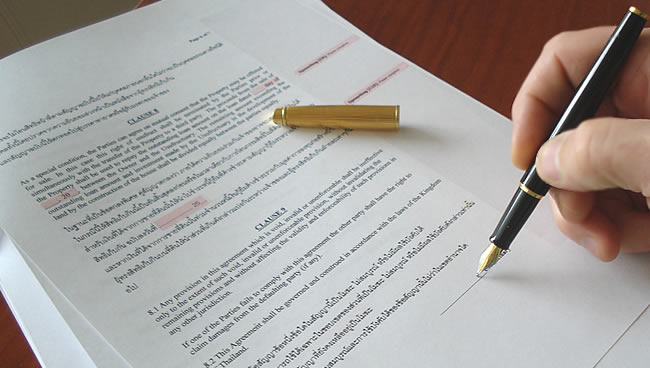
Let’s be honest—most businesses don’t think about translation errors until something goes wrong.
You sign an agreement with an overseas partner, everything looks fine, and then months later, a dispute arises. Suddenly, both sides are pointing at the same clause—but interpreting it differently.
We’ve seen this happen more times than we can count. And in many cases, the root cause isn’t bad intent—it’s flawed Thai to English localization at the clause level.
Legal documents aren’t like marketing content. Every word carries weight. A single misinterpreted clause can lead to financial loss, damaged partnerships, or even legal action.
Why Clause-Level Accuracy Matters More Than Full-Text Accuracy
Most companies focus on translating entire documents—but overlook individual clauses.
That’s a mistake.
Contracts are built on precise legal structures. Each clause defines obligations, rights, and conditions. If even one clause is slightly off, the entire agreement can become ambiguous.
For example, a clause that should imply “best effort” might be translated as “guaranteed obligation.” That’s not a small difference—it completely changes the legal responsibility.
Common Errors in Thai-to-English Legal Translation
We frequently encounter issues such as:
- Misinterpretation of conditional clauses
- Incorrect use of modal verbs like “shall,” “may,” and “must”
- Direct translation of Thai legal phrasing that doesn’t align with English legal standards
Thai legal language often relies on context and implied meaning, while English contracts demand explicit clarity. When translators fail to bridge this gap, disputes become inevitable.
The Danger of Literal Translation in Legal Documents
Literal translation is one of the biggest risks in document translation.
A sentence that works perfectly in Thai may sound unnatural—or even misleading—when translated word-for-word into English.
For example, Thai phrasing that implies flexibility may be translated into rigid contractual language. This can create obligations that were never intended by either party.
That’s why legal translation requires more than language skills—it requires legal understanding.
How Ambiguity Leads to Disputes
Ambiguity is the enemy of contracts.
When clauses are unclear, each party interprets them in their own favor. This leads to:
- Delayed projects
- Payment disputes
- Legal conflicts
We’ve worked with companies where a single unclear clause caused months of negotiation and thousands in legal fees.
All because the original translation didn’t capture the intended meaning accurately.
Differences Between Thai and English Legal Structures
Thai contracts often use longer, more fluid sentence structures, while English legal documents favor concise, structured clauses.
This structural difference creates challenges in Thai to English localization. Translators must restructure sentences—not just translate them.
Without proper adaptation, the English version may feel awkward, unclear, or legally weak.
Why Document Translation Needs Legal Expertise
Not all translators are equipped to handle legal documents.
Legal translation requires:
- Understanding of legal terminology
- Familiarity with international contract standards
- Ability to interpret intent, not just words
This is where professional document translation services make a difference. They ensure that both versions of the contract carry the same legal weight and meaning.
Preventing Costly Mistakes Through Localization
Proper localization goes beyond translation—it ensures that contracts are legally sound in both languages.
This includes:
- Aligning clauses with international legal standards
- Clarifying ambiguous phrasing
- Ensuring consistency across the document
Businesses that invest in high-quality localization reduce the risk of disputes and build stronger relationships with overseas partners.
Conclusion
Contracts are supposed to create clarity—but poor translation does the opposite.
Clause-level errors in Thai to English translation don’t just cause confusion—they create real business risks. And once a dispute arises, fixing it becomes far more expensive than preventing it.
The solution is simple: treat legal translation as a strategic investment, not a checkbox.
Work with professionals who understand both language and law. Review clauses carefully. And ensure that your agreements are clear, consistent, and aligned across both languages.
Because when it comes to contracts, precision isn’t optional—it’s everything.
FAQs
- What is clause-level translation?
It focuses on accurately translating individual contract clauses to preserve their legal meaning. - Why are legal translations more complex?
Because they require precise wording and alignment with legal systems in both languages. - Can small translation errors really cause disputes?
Yes, even minor wording differences can change obligations and lead to conflicts. - What is the role of localization in legal documents?
It adapts contracts to ensure they are legally valid and clear in both languages. - How can businesses avoid translation-related disputes?
By using professional legal translators and conducting thorough reviews before signing agreements.