

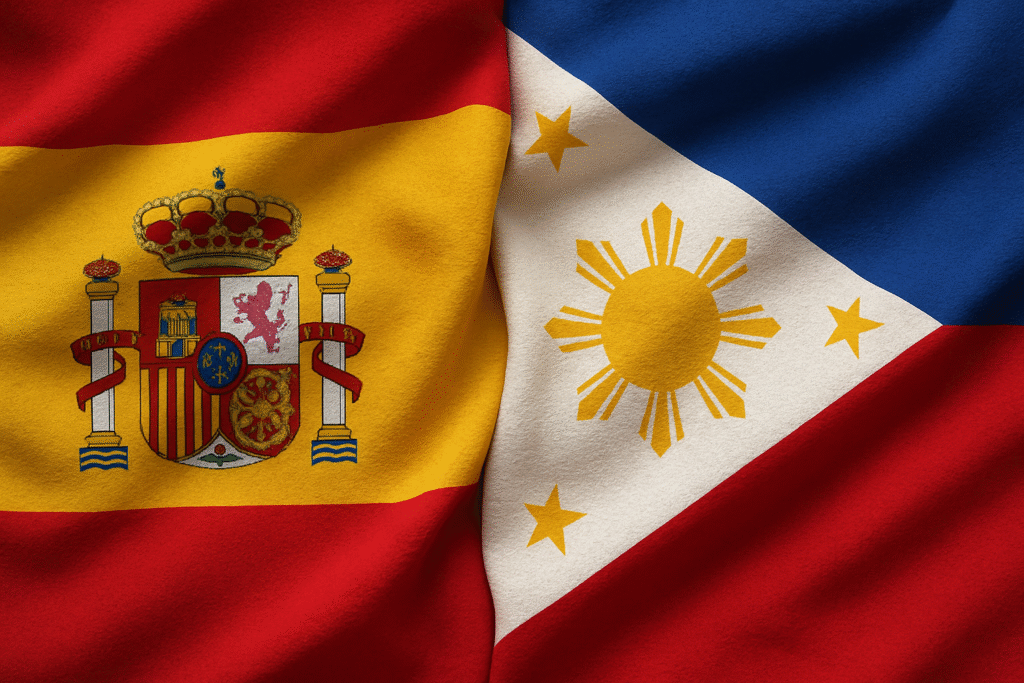
If you grew up in the Philippines, you probably use dozens of Spanish-derived words every day without even thinking about where they came from. Words like mesa (table), kutsara (spoon), asawa (spouse), kuwarto (room), and kuryente (electricity) feel inherently Filipino, yet their roots trace back to more than 300 years of Spanish colonization. This linguistic fusion isn’t just historical trivia—it’s a living ecosystem that shapes meaning, tone, and social identity. For professionals working in Filipino to English Translation / Localization, these colonial traces create a unique challenge: many Filipino terms look Spanish, sound Spanish, and sometimes even retain Spanish grammar shadows, but they no longer carry the same meaning or emotional register as their original Spanish forms.
In localization, this creates a minefield. Translators can’t simply rely on Spanish cognates or direct English substitutes, because Filipino words often have local nuances, altered connotations, or hybrid meanings. A legal term may echo Spanish authority yet mean something entirely different in Philippine jurisprudence. A simple everyday word may evoke colonial hierarchy or Catholic morality that English has no cultural space for. This article unpacks these complexities, showing how Spanish loanwords continue to shape—and sometimes distort—modern localization choices.
- The Colonial Imprint on the Filipino Lexicon
Spanish influence didn’t just add vocabulary—it reorganized how Filipinos name family roles, government structures, religious concepts, and everyday objects. Over time, these words accumulated localized layers of meaning. Today, they sit not as foreign imports, but as cultural fossils embedded in Filipino identity.
- Why Loanwords Become Localization Traps
Loanwords trick translators by pretending to be familiar. They resemble their Spanish cousins but behave differently in Filipino. Translators who assume equivalence risk mistranslating tone, formality, and cultural context, especially in legal, romantic, or religious content.
- False Friends: Filipino Words That Mislead Translators
Some Filipino-Spanish terms look identical to Spanish words yet diverge in meaning. For example:
- “Asawa” vs. “Esposa/Esposo”
In Filipino, asawa is gender-neutral. English requires specifying husband or wife.
- “Libre”
Can mean “free of charge” or “available,” depending on context—English demands clarity.
- “Kumusta”
Derived from cómo está, but used far more casually than its Spanish ancestor.
Such terms highlight the semantic drift that complicates localization.
- The Problem of Colonial Politeness and Social Distance
Spanish introduced hierarchical address terms—señor, don, doña, heneral, kapitan. While Filipino absorbed and transformed them, English lacks parallel titles with the same social resonance. Translating them risks flattening status relationships that matter in Filipino narratives.
- Religious Vocabulary With Cultural Gravity
Catholicism brought Spanish religious terminology: simbahan, kumpisal, kalbaryo, bendisyon. These words carry emotional and spiritual undertones shaped by Filipino religiosity. English equivalents like church or blessing feel sterile by comparison, losing inherited reverence.
- Bureaucratic Borrowings That Don’t Behave
Spanish loanwords dominate Philippine government and legal language—batas, abogado, hukuman, kontrata. But their usage evolved alongside Philippine legal culture, not Spanish civil code. When localizing government records, translators can’t assume Spanish logic; English legal structures differ entirely.
- Everyday Words That Carry Historical Weight
Even mundane objects can carry colonial memory:
- Kuwarto (room) reflects colonial architecture
- Sapatos (shoes) symbolizes Western status markers
- Relasyon (relationship) denotes emotional frameworks shaped by Catholic morality
These nuances subtly influence how characters act and how scenes feel in localized content.
- The Identity Conflict Embedded in Language
Many Filipinos code-switch between English, Filipino, and Spanish-derived terms. Each choice signals identity—elite, provincial, formal, informal. When localization ignores these signals, character voice collapses into generic English.
- Strategies to Localize Without Erasing History
Effective localization requires cultural empathy, not dictionary-based substitution. Translators can:
- Retain culturally loaded terms when no English equivalent exists
- Provide contextual cues instead of direct explanations
- Mirror tone and power dynamics, not just literal meaning
- Research usage, not just etymology
This preserves both message and cultural emotion.
Conclusion
Spanish loanwords in Filipino aren’t linguistic leftovers—they’re cultural artifacts shaped by centuries of coexistence, resistance, and adaptation. Their meanings evolved in uniquely Filipino directions, which is why English translations often fall short. Direct substitution ignores historical layering, emotional tone, and legal or social context. For accurate Filipino to English Translation / Localization, translators must navigate not just vocabulary but the hidden colonial architecture beneath it. Understanding these nuances allows localization work to become more than conversion—it becomes cultural stewardship. Whether you’re translating a teleserye script, a legal contract, or a tourism slogan, recognizing the colonial fingerprints embedded in Filipino words ensures your work resonates with authenticity. If Filipino is a tapestry stitched with borrowed threads, translation is the art of keeping those threads intact—without losing the pattern.
FAQs
- Are Spanish loanwords still widely used in Filipino today?
Yes. Thousands remain active in everyday speech, legal systems, and religious language. - Why can’t translators rely on Spanish meanings for Filipino terms?
Because Filipino usage evolved independently, creating different meanings and contexts. - Do Spanish loanwords affect tone in Filipino dialogue?
Absolutely. They can imply authority, politeness, class, or religiosity. - Should translators keep Spanish-derived terms in English versions?
Sometimes. Borrowing can preserve cultural nuance when English equivalents feel weak. - What makes these loanwords hard to localize?
Their meanings are layered with history, identity, and cultural emotion.